 MaanavVision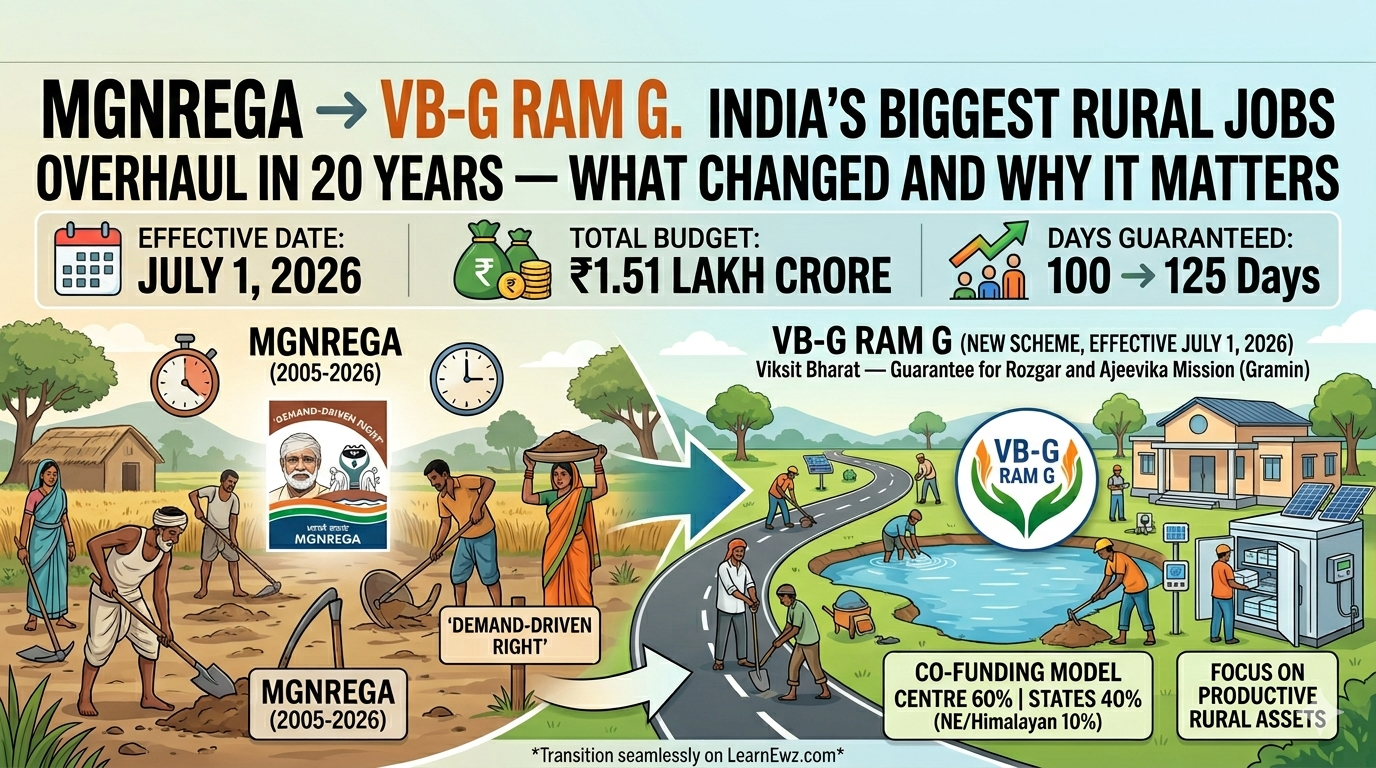
India’s Rural Jobs Law Just Changed. Here’s What That Means for Millions.
Picture this. The harvest is over. The fields are empty. There is no work in the village, no savings left, and no easy way to go to the city. In a situation like this, one law gave rural India a promise: ask for work, and you will get it. A hundred days, guaranteed, every year.
That law was MGNREGA — the Mahatma Gandhi National Rural Employment Guarantee Act, passed in 2005. For two decades, it served as a safety net for the poorest rural households in India. When nothing else worked, this did.
Now, that law has been replaced.
“ From July 1, 2026, MGNREGA stands repealed. In its place comes the VB-G RAM G Act, 2025 — India’s most significant overhaul of rural employment policy in twenty years.”
What Was MGNREGA?
When the UPA government passed MGNREGA in 2005, the idea was simple but powerful. Any adult in any Indian village who wanted unskilled manual work would be entitled to 100 days of it every year. If the government could not provide work within 15 days of the demand, it had to pay an unemployment allowance instead.
The key word here is demand-driven. A household did not need to prove poverty or wait for a project to be sanctioned. They could walk up to the Gram Panchayat, register a demand for work, and the system was legally obligated to respond.
Over twenty years, the programme employed over 14 crore active workers. Women consistently made up more than 54% of participants. A large share came from Scheduled Castes and Scheduled Tribes. The Modi government alone spent over ₹8.58 lakh crore on the scheme between 2014 and 2025.
Was it perfect? No. Wage delays were a persistent problem. So was corruption in some states. But as a floor — a basic guarantee that something was always available — it held.
What Is VB-G RAM G?
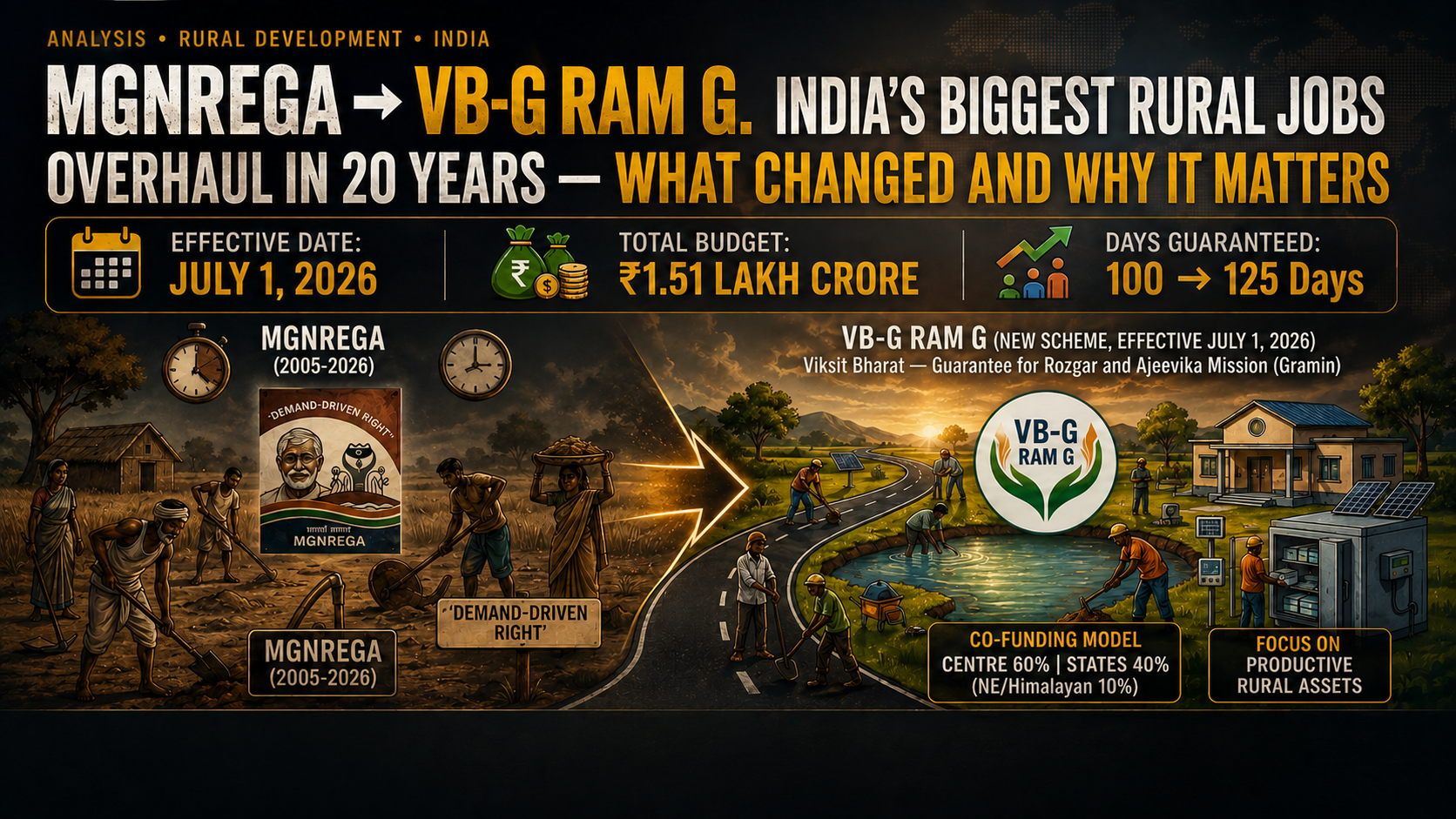
The full name of the new law is Viksit Bharat — Guarantee for Rozgar and Ajeevika Mission (Gramin) Act, 2025. It was passed in the Winter Session of Parliament in December 2025, received Presidential assent from President Droupadi Murmu, and came into force on July 1, 2026.
At first glance, the headline change looks positive: the guaranteed employment has gone up from 100 to 125 days per household per year. Wages must now be paid weekly or within 15 days, and delays attract financial compensation — a stricter standard than what existed before.
The new law also gives Gram Panchayats more say in deciding what kind of work gets done. The focus has shifted toward building productive rural assets — roads, ponds, cold storage, and community infrastructure — rather than just providing wage employment. This is designed to align with the government’s Viksit Bharat 2047 vision.
Technology-driven monitoring has been introduced to reduce corruption and track work progress more accurately.
What Is the Controversy About?
Despite the increase in guaranteed days, the new law has sparked fierce opposition across the country. Five state assemblies — Jharkhand, Karnataka, Kerala, Telangana, and Punjab — have passed formal resolutions against it. Jharkhand specifically voted to retain MGNREGA intact.
The biggest concern is money. Under MGNREGA, the central government paid 100% of labour costs. Under the new law, this has become a Centrally Sponsored Scheme, where states must contribute 40% of the total cost. For North-Eastern and Himalayan states, the share is lower at 10%.
For states that are already under fiscal stress, this is a significant burden. Bihar, for instance, already has a fiscal deficit of 9.2% of its state GDP. Meeting its new share under VB-G RAM G would require approximately ₹2,576 crore in additional spending.
The second concern is more fundamental. Critics argue that MGNREGA was a legal entitlement — a right to demand work. VB-G RAM G links employment to planning and targets, which, in their view, weakens the guarantee. If a state is unable or unwilling to fund its share, rural workers may simply not get the work they are entitled to.
There is also a political dimension. The removal of Mahatma Gandhi’s name from the scheme drew sharp criticism from the opposition. The government’s response was that names of employment schemes have been changed before — Jawahar Rozgar Yojana was renamed earlier — and that the real measure of respect is delivery, not naming.
What Happens to You If You Are a Rural Worker?
In the short term, there should be no disruption. The government has confirmed that existing MGNREGA job cards remain valid until new Gramin Rozgar Guarantee Cards are issued. Workers without job cards can still register at the Gram Panchayat level, and employment cannot be denied solely because e-KYC is pending.
In the medium term, a great deal depends on how your state government chooses to implement the new scheme. States that cooperate fully and fund their share should be able to offer 125 days of work with better wage timelines. States that struggle financially or politically may see disruptions in coverage.
One new provision worth noting: during peak agricultural seasons — sowing and harvesting — VB-G RAM G work will be paused for up to 60 days. The idea is to keep agricultural labour available in the fields. Critics say this reduces the scheme’s usefulness precisely when rural incomes are lowest.
“The real test of this law will come in the first three months after July 1. Watch whether 125 days actually reach the workers who need them most.”
VB-G RAM G is not simply a name change. It is a structural reset of how India thinks about rural employment — moving from a demand-driven legal right toward a planned, asset-building, co-funded programme. Whether that is an upgrade or a step backward will depend entirely on whether the promise of 125 days turns into reality at the ground level.
VB-G RAM G Act, 2025
UPSC / GPSC Preparation Notes
WHY IN NEWS
- Central Government notified the VB-G RAM G Act, 2025 on May 11, 2026 via gazette notification.
- MGNREGA (2005) stands repealed with effect from July 1, 2026.
- Bill passed during Winter Session of Parliament, December 2025.
- President Droupadi Murmu gave assent; Ministry of Rural Development to oversee implementation.
- Parliamentary panel chief Saptagiri Ulaka demanded a phased 6-month overlap; request rejected.
MGNREGA AT A GLANCE (What Is Being Replaced)
- Full name: Mahatma Gandhi National Rural Employment Guarantee Act, 2005.
- Type: Demand-driven, rights-based legal entitlement.
- Guarantee: 100 days of unskilled manual wage employment per rural household per year.
- Unemployment allowance if work not provided within 15 days of demand.
- Funding: Centre paid 100% of labour cost + 75% of material cost; states paid 25% of material cost
- Women participation: consistently above 54% of total person-days.
- SC/ST participation: approximately 40%+ of total person-days.
- Cumulative NDA spending (2014–25): over ₹8.58 lakh crore.
- Active workers: 14+ crore at peak.
KEY FEATURES OF VB-G RAM G ACT, 2025
- Full name: Viksit Bharat — Guarantee for Rozgar and Ajeevika Mission (Gramin) Act, 2025.
- Employment guarantee increased from 100 days to 125 days, Per household per financial year.
- States opposing the law: Jharkhand, Karnataka, Kerala, Telangana and Punjab.
- Wage payment: weekly or within 15 days; financial compensation mandated for any delay.
- Existing MGNREGA e-KYC job cards remain valid until new Gramin Rozgar Guarantee Cards are issued
- Workers without job cards may still register at Gram Panchayat level
- Employment cannot be denied solely on grounds of pending e-KYC
- Gram Panchayats repositioned as central unit of rural transformation
- Focus on creating productive rural assets aligned with Viksit Bharat @2047
- Technology-driven monitoring system introduced for transparency
- Mandatory 60-day work suspension during peak agricultural seasons (sowing and harvesting)
- Supervised by a new Central Gramin Rozgar Guarantee Council
FUNDING STRUCTURE: OLD vs NEW
| MGNREGA (Old) | VB-G RAM G (New) |
|---|---|
| Centre: 100% Labour Cost | Centre: 60% of Total Programme cost |
| Centre: 75% Material Cost | General States: 40% of Total Cost |
| States: 25% Material Cost Only | NE / Himalayan States: 10% of Total Cost |
| Fully Central funding for Labour | Centrally Sponsored Scheme (CSS) Model |
• Centre’s FY 2026–27 allocation: ₹95,692.31 crore (highest ever for rural employment)
• Total outlay including state contributions: ₹1.51 lakh crore+
CONCERNS AND CRITICISMS
1. Fiscal Burden on States
- 40% state share places significant strain on states with weak fiscal capacity
- Bihar: requires ~₹2,576 crore additional spending; fiscal deficit already at 9.2% of GSDP
- Chhattisgarh and Jharkhand also assessed as highly vulnerable
- Gujarat, Maharashtra, Haryana: estimated impact only ~0.05% of GSDP (relatively cushioned)
2. Shift from Demand-Driven to Supply-Driven
- MGNREGA was a legal entitlement: rural workers could demand work as a right
- VB-G RAM G links employment to planning, targets, and state funding capacity
- Critics argue: if a state cannot afford its 40%, workers may lose coverage with no legal recourse
- Reduces distress protection during agricultural lean periods
3. Political and Symbolic Controversy
- Removal of ‘Mahatma Gandhi’ from scheme name drew sharp opposition response
- Opposition MPs — including Priyanka Gandhi Vadra, Shashi Tharoor, TR Baalu — protested at Parliament
- Demanded Bill be referred to Parliamentary Standing Committee; government declined
- Opposition framed change as converting a legal right into a government scheme
4. State-Level Resistance
- Five state assemblies passed formal resolutions against the new law:
- Jharkhand: voted to retain MGNREGA intact
- Karnataka, Kerala, Telangana, Punjab: passed anti-VB-G RAM G resolutions
- Risk: non-cooperative states may underperform on implementation, harming workers
GOVERNMENT’S DEFENCE
- 125 days guarantee is a quantitative improvement over 100 days
- Technology-driven monitoring will reduce corruption and wage delays
- Highest-ever budgetary allocation demonstrates strong commitment
- Name changes to employment schemes are not unprecedented (Jawahar Rozgar Yojana → NREGA → MGNREGA)
- Gram Panchayat empowerment aligns with the spirit of the 73rd Constitutional Amendment
- Transition described as ‘seamless and worker-centric’ by Ministry of Rural Development
SIGNIFICANCE
- Affects approximately 15 crore rural households and 14+ crore active workers
- Single largest restructuring of rural employment policy since MGNREGA’s introduction in 2005
- Tests Centre-state cooperative federalism under the CSS funding model
- Key indicator of whether ‘Viksit Bharat’ vision reaches the poorest and most marginalised
- Benchmark for rights-based vs scheme-based approach to social protection in India
WAY FORWARD
- Ensure zero disruption in job card transition; no worker denied employment during administrative shift
- Centre should consider bridge funding or grace period for fiscally stressed states
- Robust digital grievance redressal mechanism must be operational before July 1
- Independent impact assessment required after 6 months — especially on women and SC/ST participation rates
- Parliamentary Standing Committee should actively monitor implementation and flag coverage gaps
- States should be incentivised, not penalised, for early adoption and high performance
PRELIMS POINTERS — 3 MUST-KNOW FACTS
- Full name: Viksit Bharat — Guarantee for Rozgar and Ajeevika Mission (Gramin) Act, 2025 | Effective: July 1, 2026
- Key change: 100 → 125 days | New funding: Centre 60%, States 40% (NE/Himalayan states: 10%)
- States opposing via assembly resolutions: Jharkhand, Karnataka, Kerala, Telangana, Punjab
ONE-LINE RECALL
VB-G RAM G = MGNREGA’s successor (125 days, technology-driven, co-funded) — progressive in intent, contested in structure and implementation.