 MaanavVision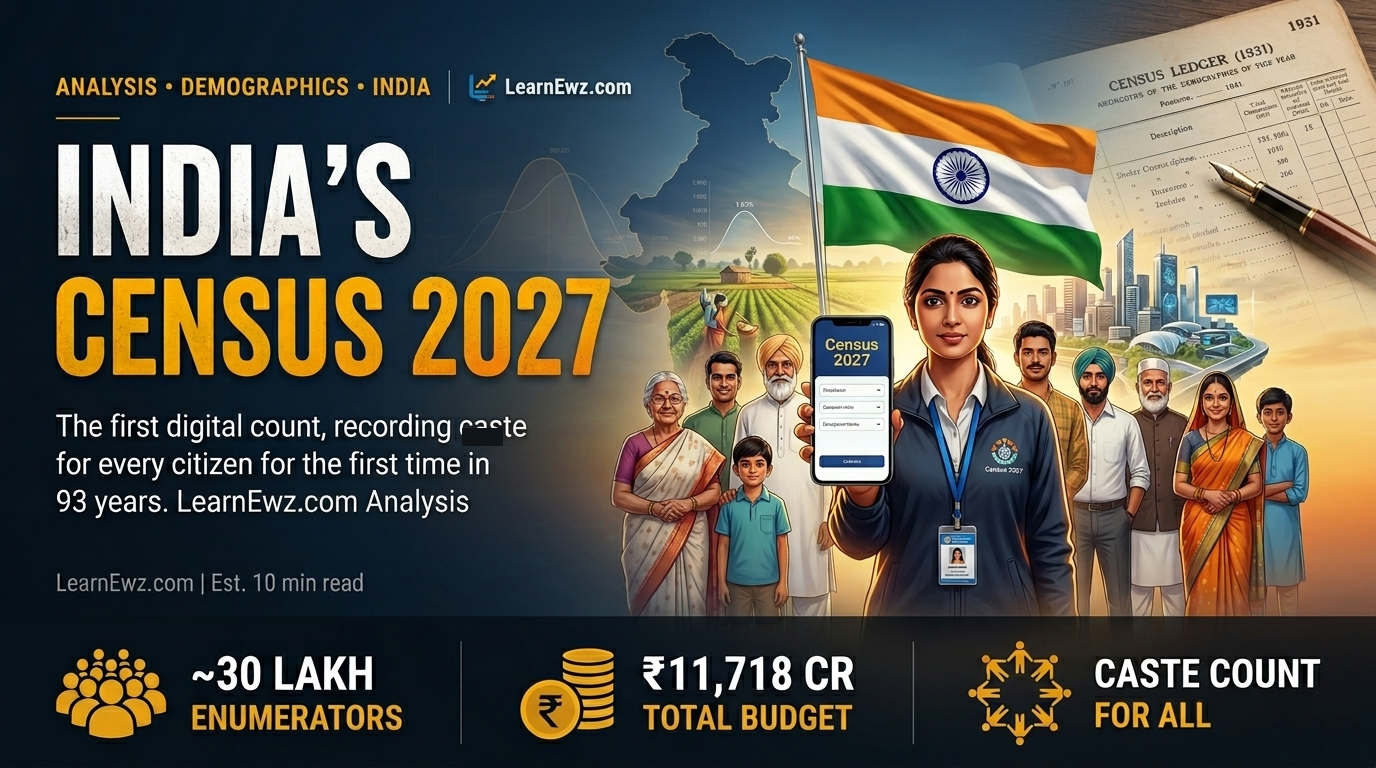
India Is Counting Itself — And This Time, Nothing Is Left Out
It is a February morning in 1931. Somewhere in the vast, dusty plains of what is now Uttar Pradesh, a man is walking from house to house. He is not a government officer in uniform. He is a schoolteacher, pressed into service for a few weeks by the British colonial administration. He carries a thick paper form and a fountain pen.
He knocks on a door. A woman answers. He asks her name, her age, how many children she has, what her husband does, what religion they follow. And then, the question he has been told to ask every single household in his area:
What is your caste?
She tells him. He writes it down carefully in the column provided. He moves to the next house. Then the next. Then the next. By the time his section is done, he has knocked on hundreds of doors and recorded hundreds of caste names in that ledger.
He had no way of knowing, as he walked away that morning, that what he had just done would not be done again for ninety-three years.
“The 2027 Census will be the first time since that 1931 exercise that India officially records the caste of every single citizen — not just Scheduled Castes and Tribes, but every community across the nation.”
But that is only one part of what makes Census 2027 remarkable. It is also India’s first digital Census. It is happening after an unprecedented sixteen-year gap. And its results will redraw the country’s political map, reshape its reservation policies, and determine who gets what for the next decade.
To understand all of that, we need to start at the beginning.
What Is a Census?
A Census is the official headcount of an entire country’s population. Not a sample. Not an estimate. Every single person, in every single household, in every single village, town, and city.
But it is much more than just counting heads. It is a detailed portrait of a nation. Who lives where. How they live. What they own. What language they speak. What religion they follow. How much education they have. What work they do. Whether they are disabled. Whether they migrated from somewhere else.
Think of it like a full medical check-up for a country — not just weight and height, but blood pressure, cholesterol, vision, and everything else. The data that comes out of a Census is used for decades to make decisions about where to build schools, how much food to allocate to a district, how many hospital beds a region needs, and which communities deserve special support.
🏥 A Census is like a country’s medical file
A doctor cannot treat a patient without knowing their current health status. Similarly, a government cannot run welfare schemes, build infrastructure, or draw electoral boundaries without knowing its population — how many people, where they are, and what their conditions are. The Census is that file. And India has been working from a file last updated in 2011.
India has conducted a Census every ten years since 1881. That is fourteen consecutive Censuses — through Partition, through wars, through famines, through every political upheaval the country has faced. Not a single one was missed.
Until 2021.
The Census Exercise That Has Just Begun
India’s 16th Census — delayed by six years from its original 2021 schedule — is now officially underway. Phase 1, called the House Listing exercise, began on April 1, 2026. It is running right now, across every state and Union Territory in the country.
The process will conclude with the official headcount in February 2027. March 1, 2027 at midnight is the reference date — the precise moment India officially counts itself.
Citizens can now also self-enumerate online at se.census.gov.in — fill their own household details, get a unique ID, and hand that ID to the enumerator when they visit. This is entirely new and did not exist in 2011.
Why Is a Census Conducted?
The Census is not just an administrative exercise. It is the engine that runs most of India’s governance.
- First: welfare allocation. How many ration cards should a district get? How many mid-day meal students are there in a school? How much MGNREGA funding does a block need? All of these calculations flow from Census population data. Without an accurate Census, welfare schemes are either over-funded in areas that have shrunk or under-funded in areas that have grown.
- Second: infrastructure planning. The government uses Census data to decide where to build hospitals, primary health centres, roads, and schools. A village that was 500 people in 2011 and is now 900 people in 2026 is not getting the infrastructure it needs — because no one officially knows it has grown.
- Third: electoral representation. India’s Constitution mandates that Lok Sabha constituencies be redrawn based on the most recent Census. The number of reserved seats for Scheduled Castes and Tribes in Parliament and Assemblies is calculated from Census population proportions.
- Fourth: policy making. From designing poverty alleviation schemes to planning urban housing, from measuring literacy gains to tracking migration patterns — Census data is what tells the government whether its programmes are working and where the gaps are.
📊 Running a country without Census data is like…
Imagine a city’s municipality trying to plan next year’s water supply without knowing how many people live in each neighbourhood. It would either waste water where populations have moved away, or leave new colonies dry. That is what India has been doing across every sector for fifteen years — planning for a population it hasn’t accurately measured since 2011.
How Is It Conducted?
The Census happens in two phases, separated by several months.
- Phase 1 is the House Listing exercise Enumerators — around thirty lakh of them, mostly school teachers — visit every structure in India. Not just homes. Every office, factory, hospital, temple, shop, and institution. They record what the building is used for, what it is made of, how many rooms it has, whether it has piped water, what kind of toilet, what cooking fuel is used, and what assets the household owns: TV, phone, vehicle, internet connection.
- Phase 2 is the Population Enumeration This is the actual headcount. Every individual person is recorded: name, age, sex, date of birth, relationship to the household head, marital status, level of education, occupation, religion, mother tongue, disability, migration history. Even the homeless are counted. Even newborn babies.In 2027, enumerators will use a smartphone app instead of paper forms. They will select answers from standardised drop-down menus. The data uploads to a central server instantly. Supervisors can monitor progress on a real-time national dashboard. Errors are flagged automatically.
📱 Why drop-down menus matter more than you think
In 2011, enumerators wrote caste names and occupations by hand. One community might be spelled ‘Kurmi’ in one district and ‘Kurumi’ in another. Processing these variations took years of manual work and still produced errors. In 2027, the enumerator selects from a pre-coded list. Every entry is standardised. What used to take two years to process can now be done in two weeks.
Provisional population data is expected within ten days of the February 2027 headcount — a dramatic improvement over the months it took in 2011. Final data, including caste tables, will take longer to verify and publish — likely two to three years.
How Does India Compare With the World?
India is not alone in conducting a national Census — but its scale, complexity, and the data it collects makes it one of the most ambitious exercises of its kind anywhere in the world.
| Country | Census Frequency | Notable Feature |
|---|---|---|
| 🇮🇳 India | Every 10 years (now 16 yrs) | World’s largest Census exercise; 30 lakh enumerators; first digital in 2027 |
| 🇺🇸 USA | Every 10 years | Online self-enumeration primary method; no caste data collected |
| 🇨🇳 China | Every 10 years | Door-to-door + self-registration; 7 million enumerators in 2020 |
| 🇬🇧 UK | Every 10 years | Last Census: 2021; fully online for first time; ethnicity (not caste) recorded |
| 🇧🇷 Brazil | Every 10 years | Racial/colour categories recorded; 2022 Census after 12-year delay |
| 🇸🇬 Singapore | Every 10 years | Fully digital since 2010; race and language data collected |
One key difference: India is one of very few democracies attempting to collect caste data at a national scale. Most countries collect racial or ethnic categories, but the granularity of caste enumeration — thousands of sub-groups, varying by region and language — is uniquely Indian in its complexity.
The United States collects race and ethnicity data, which it uses to enforce anti-discrimination laws and target welfare schemes. India’s caste data will serve a similar function — but the categories are far more numerous and far more politically charged.
What Is New in Census 2027?
Census 2027 is different from every Census before it in ways that go well beyond technology. Here is a clear summary of what is genuinely new.
| ✨ What’s New in Census 2027 at a Glance
📱 FIRST DIGITAL CENSUS: Smartphone app, GPS tagging, drop-down menus, real-time monitoring dashboard (CMMS) 🏠 SELF-ENUMERATION: Citizens can fill their own details online at se.census.gov.in before the enumerator visits 🧬 CASTE FOR ALL: For the first time since 1931, caste is recorded for every community — not just SC and ST ⚧️ TRANSGENDER OPTION: Explicit third-gender option added to the population enumeration form 🌧️ CLIMATE MIGRATION: New question on whether a person migrated due to a climate event or natural disaster 📶 DIGITAL LIFE QUESTIONS: Internet connection at home, smartphone ownership — new development indicators 🚗 VEHICLE DETAILS: Type of vehicle owned (two-wheeler, four-wheeler, commercial) now separately recorded ⚡ GAS TYPE: Piped natural gas vs LPG cylinder — distinguishes energy access quality ⚡ SPEED: Provisional data expected within 10 days of headcount (vs months in 2011) |
The caste enumeration deserves special mention. The 27% OBC reservation in government jobs was fixed by the Mandal Commission in 1980 — based on estimates, not a Census count. For forty-five years, one of India’s most consequential policies has rested on a number that was never officially verified. Census 2027 will, for the first time, produce a number.
What India does with that number — whether it adjusts reservations, creates sub-quotas within OBC categories, or challenges the Supreme Court’s 50% ceiling — is a debate that has not even properly started yet. But the data, once it exists, will make it impossible to avoid.
“`
What Benefits Do We Get From a Census?
Better Welfare Targeting
Ration allocations, MGNREGA funds, scholarship eligibility, housing schemes — all recalculated with accurate 2027 population data. Districts that have grown get more. Communities that are larger than estimated get their fair share.
Infrastructure Where It Is Actually Needed
The government will know where to build new schools, hospitals, and roads based on where people actually live today — not where they lived in 2011. Rapid urbanisation means many cities are severely under-served because their official population is fifteen years old.
Fair Political Representation
Lok Sabha and Assembly constituencies will be redrawn based on actual 2027 population. Citizens in areas that have grown will finally get the representation they deserve. This also triggers the Women’s Reservation Act — 33% of parliamentary seats for women cannot be activated until after this delimitation.
First-Ever OBC Population Data
Census 2027 will produce the first official count of Other Backward Classes in independent India. This data could reshape how reservations work, whether sub-quotas within OBC are justified, and whether the policy built on the 1980 Mandal Commission estimates needs updating.
Smarter Policy for a Changed India
India in 2027 is profoundly different from India in 2011. More urban. More digitally connected. More mobile. Census data will reflect this changed reality and allow policy to catch up — on climate migration, digital access, clean energy penetration, and much more.
“`
What Details Will You Share With the Enumerator?
When the enumerator knocks on your door — or when you self-enumerate online — here is a clear picture of what you will be asked to share, and why each question is asked.
| Question | Why It Is Asked |
|---|---|
| Name, Age, Date of Birth | Basic demographic data; determines age pyramid, dependency ratio |
| Sex / Gender (incl. Transgender) | Gender composition of population; policy planning for women and third gender |
| Marital Status | Tracks family formation patterns and demographic trends |
| Education Level | Measures literacy and educational attainment across regions |
| Occupation | Tracks employment patterns; identifies which sectors employ which communities |
| Religion | Constitutional requirement; used for minority welfare schemes |
| Caste (NEW for all) | First since 1931; used for reservation policy and OBC welfare planning |
| Mother Tongue | Language planning; medium of instruction in schools |
| Disability Status | Planning for disability support services and infrastructure |
| Migration History | Tracks internal migration; identifies climate or disaster displacement (NEW) |
| House Construction Material | Measures housing quality; identifies Kutcha/Pucca housing for schemes |
| Water & Toilet Access | Tracks Swachh Bharat progress; sanitation planning |
| Cooking Fuel Type | Tracks Ujjwala Yojana coverage; clean energy penetration |
| Internet & Smartphone (NEW) | Measures digital divide; Digital India programme assessment |
| Vehicle Type (NEW) | Mobility and economic status indicator |
| Gas Connection Type (NEW) | Piped gas vs LPG; energy infrastructure planning |
Your information is legally protected under the Census Act, 1948. It cannot be used for taxation, legal proceedings, or any purpose other than statistical analysis. No individual-level data is ever published. Your privacy is guaranteed by law.
🔒 Is your data safe?
Under Section 15 of the Census Act, 1948, it is a criminal offence for any Census official to disclose information about any individual household. Your name, caste, income, or any other detail collected in the Census cannot be used against you in any court, by any tax authority, or by any government department. The data is only ever published in aggregate form — as totals and percentages, never as individual records.
Is the Census Truly Necessary? Back to 1931.
Let us return to that schoolteacher walking through a village in 1931.
He filled in that ledger dutifully. The British government processed the data, published it, and used it to govern India. Among the things that data revealed was the size of different caste communities across the country — information that would become relevant to every debate about representation, reservation, and rights that followed independence.
Then the counting stopped. In 1941, caste data was collected but never published — the government decided it was too sensitive to release during wartime. After independence, the new Indian state decided that counting caste would reinforce divisions rather than help heal them. So the Census continued every decade, but the caste column disappeared.
For seventy-six years, India tried to govern its most complex social reality without measuring it.
The consequences are visible everywhere. The OBC reservation, one of the largest affirmative action programmes in the world, rests on a 45-year-old estimate. Courts have been asked to rule on whether reservations are proportional without any data on actual proportions. State governments have conducted their own caste surveys and come up with wildly different numbers, creating political chaos rather than clarity.
What the 2027 Census offers, for the first time in living memory, is a fact-based starting point. Not an estimate. Not a survey. A proper, official, nationally-conducted count of who is here, how many there are, and where they live.
“A Census does not create social divisions. Those divisions already exist. What a Census does is make them legible — so that a government can address them with evidence rather than assumption.”
That schoolteacher in 1931 was doing something important when he asked that woman her caste and wrote it down. He was making her visible in the eyes of the state. Every person he recorded became a data point that could be counted, compared, and acted upon.
In February 2027, another enumerator — this one carrying a smartphone, this one asking the same question from a drop-down menu — will do the same thing again. For the first time in ninety-three years.
The question is what India will do with the answer.
DATA & SOURCES
Research & Reference Material
Government & Public Data
- The Hindu (Vijaita Singh, June 4, 2025)
- The Hindu (Anish Gupta & Shubham Sharma, Dec 2024)
- Indian Express (Deeptiman Tiwary, June 17, 2025)
- ISAS (Ronojoy Sen, June 2025)
- Census Act 1948 · PIB / MHA