 MaanavVision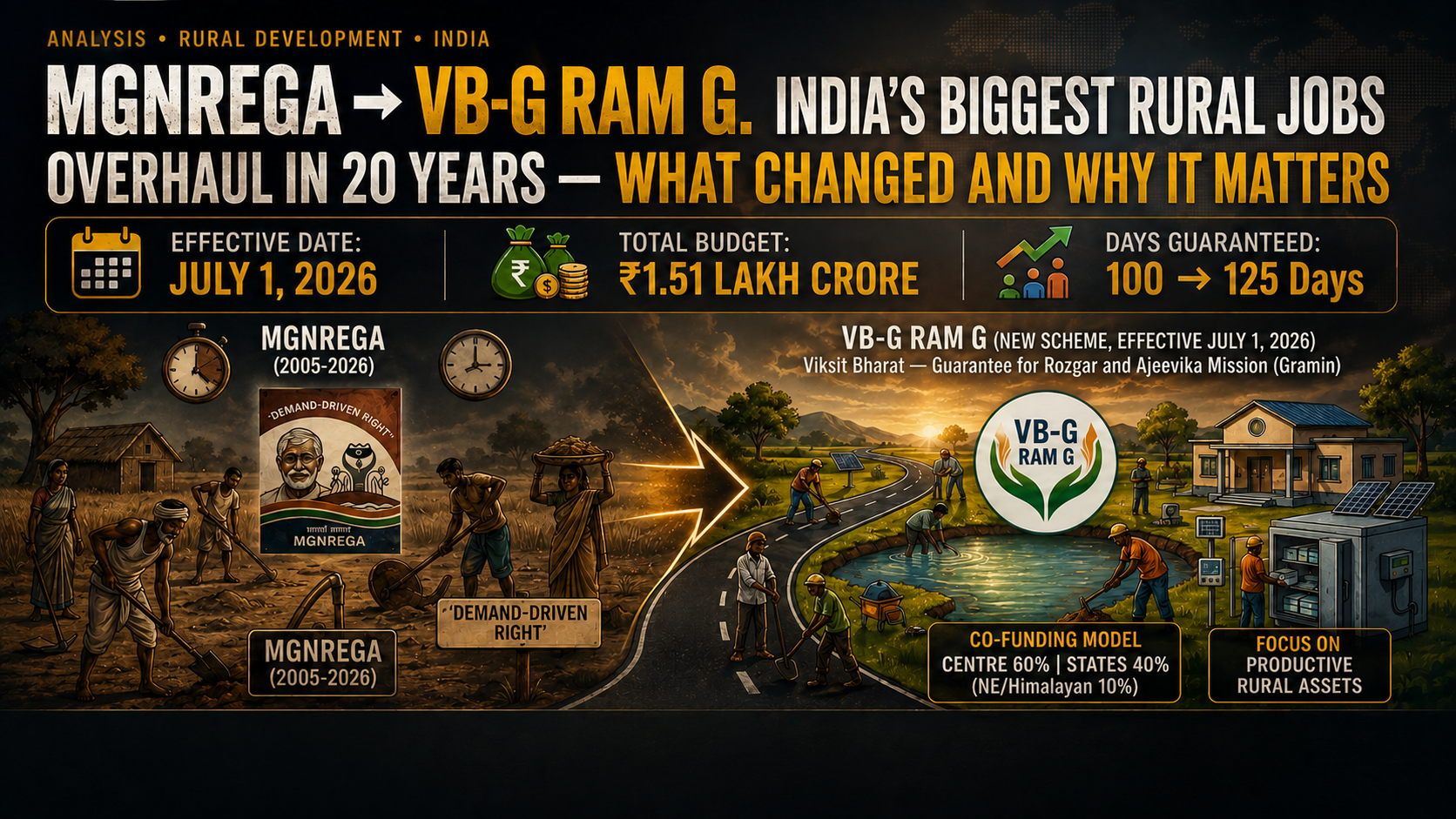
MGNREGA Gayi, VB-G RAM G Aayi — Gaon Ki Naukri Ka Naya Adhyaay
Imagine karo — tumhare gaon mein koi kaam nahi hai. Fasal kat gayi, khet khali hain, aur paisa khatam hone wala hai. Aisi situation mein ek guarantee thi — ek kanoon jo kehta tha: ‘Kaam maango, hum denge. 100 din, guaranteed.’
Yeh kanoon tha MGNREGA — Mahatma Gandhi National Rural Employment Guarantee Act, 2005. Pichle 20 salon mein, isi kanoon ne karodo garib gramin parivaaron ko ek safety net diya. Jab kuch nahi tha, yeh tha.
Ab woh kanoon badal gaya hai.
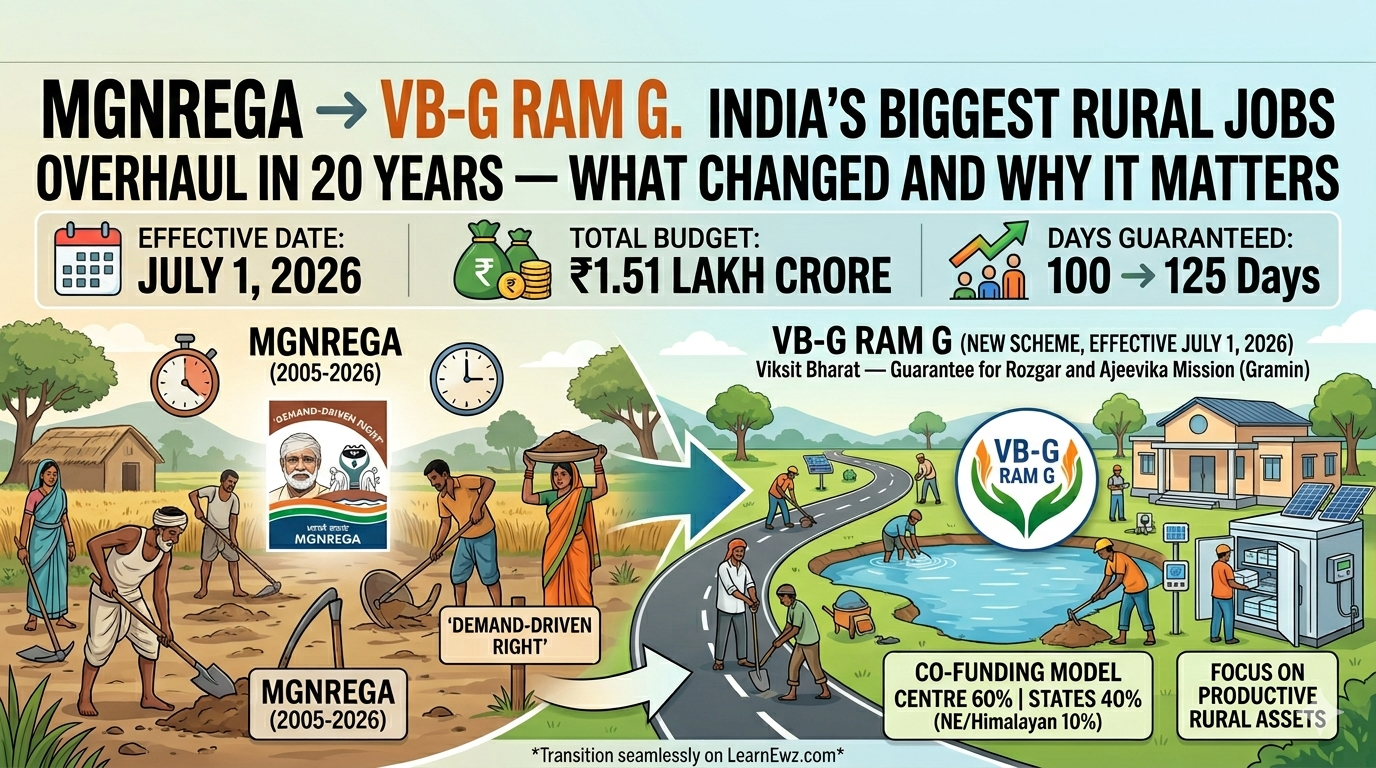
“1 July 2026 se, MGNREGA ki jagah aaya hai VB-G RAM G — Viksit Bharat Guarantee for Rozgar and Ajeevika Mission (Gramin).”
Pehle Samjho — MGNREGA Tha Kya?
2005 mein UPA sarkar ne yeh kanoon banaya tha ek simple promise ke saath: India ke kisi bhi gaon ka koi bhi baligh vyakti jo kaam karna chahta ho, use 100 din ka guaranteed kaam milega ek saal mein. Kaam na mile toh bhatta milega.
Yeh demand-driven tha — matlab agar aap maango, toh milega. Sarkar ko dekhna padta tha ki kitne log maang rahe hain aur utna kaam banana padta tha.
Iske naam mein ‘Mahatma Gandhi’ baad mein joda gaya — 2009 mein. Aur isi naam ko lekar aaj sabse badi rajniti chal rahi hai.
Ab Kya Badla — 5 Badi Cheezein
Pehli baat — kaam ke din badhaye gaye hain. 100 se 125 din. Yeh seedha faida hai.
Doosri baat — paisa kaise aayega, yeh badla hai. Pehle central sarkar 100% labor cost deti thi. Ab yeh ek ‘Centrally Sponsored Scheme’ ban gaya hai — yaani state ko bhi 40% contribute karna hoga. Pahadi aur North-East states ke liye yeh 10% hai.
Teesri baat — ek naya niyam aaya hai: farming season ke dauran, jab khet mein kaam hota hai, toh is scheme ke kaam 60 din ke liye rok diye jaayenge. Logic yeh hai ki mazdooron ko kheti mein rehna chahiye. Critics kehte hain yeh distress protection kam karta hai.
Chauthi baat — ab Gram Panchayats ko zyada power di gayi hai kaam chunne mein. Focus hoga ‘productive rural assets’ banana — roads, ponds, storage, etc.
Paanchvi baat — technology-driven monitoring. Weekly wage payment ya 15 din mein — aur agar late ho toh compensation milega.
Toh Virodh Kyun Ho Raha Hai?
Jharkhand, Karnataka, Kerala, Telangana, Punjab — in saare states ki assemblies ne resolutions paas karke kaha hai ki hum yeh nahi chahte.
Sabse bada darr hai — 40% state share. Bihar jaisa state, jiska fiscal deficit pehle se 9.2% hai, usse 2,576 crore extra dene honge. Garib states pe sabse zyada bhar padega.
Doosri chinta — yeh ab ‘demand-driven right’ nahi raha. Pehle kaam maango toh milta tha. Ab kaam milega ya nahi yeh depend karega state ki financial capacity aur planning par. Guarantee kamzor hoti lagi hai.
Opposition ka aur ek emotional sawaal — Mahatma Gandhi ka naam kyun hataya? Sarkar kehti hai naam change karna bejzzati nahi hai — pehle bhi Jawahar Rozgar Yojana ka naam badla gaya tha. Phir bhi yeh debate abhi bhi hot hai.
Sarkar Ka Paksh Kya Hai?
Rural Development Minister Shivraj Singh Chouhan kehte hain — pehle corruption zyada thi, ab technology se woh kam hogi. Kaam ke din 100 se 125 hue hain. Wage delay pe penalty hai. Budget sabse zyada — Rs 95,692 crore sirf Centre se, total 1.51 lakh crore. Yeh sab positive signs hain.
Sarkar ka maanna hai ki 20 saal purane framework ko modernise karna zaroori tha. Viksit Bharat 2047 ke vision ke liye gaon mein sirf kaam nahi, productive assets bhi chahiye.
Aapke Gaon Pe Kya Asar?
Abhi ke liye — koi fark nahi. Purane job cards valid rahenge jab tak naye Gramin Rozgar Guarantee Cards nahi aate. Gram Panchayat mein register karne ka option bana rahega.
Aage ke liye — yeh depend karega aapke state ki sarkar kitni efficiently scheme implement karti hai. Jo states zyada cooperative hain, wahan workers ko 125 din aur better wages milne chahiye. Jo states struggle karein financial ya administrative taur pe, wahan disruption ho sakti hai.
“Yeh sirf naam change nahi hai. Yeh India ki rural employment policy ka sabse bada overhaul hai 2005 ke baad.”
July 1 aa raha hai. Dekhte hain gaon tak yeh naya kanoon kaise pahunchta hai.
VB-G RAM G Act, 2025
UPSC / GPSC Preparation Notes
WHY IN NEWS
- Central Government notified the VB-G RAM G Act, 2025 on May 11, 2026 via gazette notification.
- MGNREGA (2005) stands repealed with effect from July 1, 2026.
- Bill passed during Winter Session of Parliament, December 2025.
- President Droupadi Murmu gave assent; Ministry of Rural Development to oversee implementation.
- Parliamentary panel chief Saptagiri Ulaka demanded a phased 6-month overlap; request rejected.
MGNREGA AT A GLANCE (What Is Being Replaced)
- Full name: Mahatma Gandhi National Rural Employment Guarantee Act, 2005.
- Type: Demand-driven, rights-based legal entitlement.
- Guarantee: 100 days of unskilled manual wage employment per rural household per year.
- Unemployment allowance if work not provided within 15 days of demand.
- Funding: Centre paid 100% of labour cost + 75% of material cost; states paid 25% of material cost
- Women participation: consistently above 54% of total person-days.
- SC/ST participation: approximately 40%+ of total person-days.
- Cumulative NDA spending (2014–25): over ₹8.58 lakh crore.
- Active workers: 14+ crore at peak.
KEY FEATURES OF VB-G RAM G ACT, 2025
- Full name: Viksit Bharat — Guarantee for Rozgar and Ajeevika Mission (Gramin) Act, 2025.
- Employment guarantee increased from 100 days to 125 days, Per household per financial year.
- States opposing the law: Jharkhand, Karnataka, Kerala, Telangana and Punjab.
- Wage payment: weekly or within 15 days; financial compensation mandated for any delay.
- Existing MGNREGA e-KYC job cards remain valid until new Gramin Rozgar Guarantee Cards are issued
- Workers without job cards may still register at Gram Panchayat level
- Employment cannot be denied solely on grounds of pending e-KYC
- Gram Panchayats repositioned as central unit of rural transformation
- Focus on creating productive rural assets aligned with Viksit Bharat @2047
- Technology-driven monitoring system introduced for transparency
- Mandatory 60-day work suspension during peak agricultural seasons (sowing and harvesting)
- Supervised by a new Central Gramin Rozgar Guarantee Council
FUNDING STRUCTURE: OLD vs NEW
| MGNREGA (Old) | VB-G RAM G (New) |
|---|---|
| Centre: 100% Labour Cost | Centre: 60% of Total Programme cost |
| Centre: 75% Material Cost | General States: 40% of Total Cost |
| States: 25% Material Cost Only | NE / Himalayan States: 10% of Total Cost |
| Fully Central funding for Labour | Centrally Sponsored Scheme (CSS) Model |
• Centre’s FY 2026–27 allocation: ₹95,692.31 crore (highest ever for rural employment)
• Total outlay including state contributions: ₹1.51 lakh crore+
CONCERNS AND CRITICISMS
1. Fiscal Burden on States
- 40% state share places significant strain on states with weak fiscal capacity
- Bihar: requires ~₹2,576 crore additional spending; fiscal deficit already at 9.2% of GSDP
- Chhattisgarh and Jharkhand also assessed as highly vulnerable
- Gujarat, Maharashtra, Haryana: estimated impact only ~0.05% of GSDP (relatively cushioned)
2. Shift from Demand-Driven to Supply-Driven
- MGNREGA was a legal entitlement: rural workers could demand work as a right
- VB-G RAM G links employment to planning, targets, and state funding capacity
- Critics argue: if a state cannot afford its 40%, workers may lose coverage with no legal recourse
- Reduces distress protection during agricultural lean periods
3. Political and Symbolic Controversy
- Removal of ‘Mahatma Gandhi’ from scheme name drew sharp opposition response
- Opposition MPs — including Priyanka Gandhi Vadra, Shashi Tharoor, TR Baalu — protested at Parliament
- Demanded Bill be referred to Parliamentary Standing Committee; government declined
- Opposition framed change as converting a legal right into a government scheme
4. State-Level Resistance
- Five state assemblies passed formal resolutions against the new law:
- Jharkhand: voted to retain MGNREGA intact
- Karnataka, Kerala, Telangana, Punjab: passed anti-VB-G RAM G resolutions
- Risk: non-cooperative states may underperform on implementation, harming workers
GOVERNMENT’S DEFENCE
- 125 days guarantee is a quantitative improvement over 100 days
- Technology-driven monitoring will reduce corruption and wage delays
- Highest-ever budgetary allocation demonstrates strong commitment
- Name changes to employment schemes are not unprecedented (Jawahar Rozgar Yojana → NREGA → MGNREGA)
- Gram Panchayat empowerment aligns with the spirit of the 73rd Constitutional Amendment
- Transition described as ‘seamless and worker-centric’ by Ministry of Rural Development
SIGNIFICANCE
- Affects approximately 15 crore rural households and 14+ crore active workers
- Single largest restructuring of rural employment policy since MGNREGA’s introduction in 2005
- Tests Centre-state cooperative federalism under the CSS funding model
- Key indicator of whether ‘Viksit Bharat’ vision reaches the poorest and most marginalised
- Benchmark for rights-based vs scheme-based approach to social protection in India
WAY FORWARD
- Ensure zero disruption in job card transition; no worker denied employment during administrative shift
- Centre should consider bridge funding or grace period for fiscally stressed states
- Robust digital grievance redressal mechanism must be operational before July 1
- Independent impact assessment required after 6 months — especially on women and SC/ST participation rates
- Parliamentary Standing Committee should actively monitor implementation and flag coverage gaps
- States should be incentivised, not penalised, for early adoption and high performance
PRELIMS POINTERS — 3 MUST-KNOW FACTS
- Full name: Viksit Bharat — Guarantee for Rozgar and Ajeevika Mission (Gramin) Act, 2025 | Effective: July 1, 2026
- Key change: 100 → 125 days | New funding: Centre 60%, States 40% (NE/Himalayan states: 10%)
- States opposing via assembly resolutions: Jharkhand, Karnataka, Kerala, Telangana, Punjab
ONE-LINE RECALL
VB-G RAM G = MGNREGA’s successor (125 days, technology-driven, co-funded) — progressive in intent, contested in structure and implementation.