 MaanavVision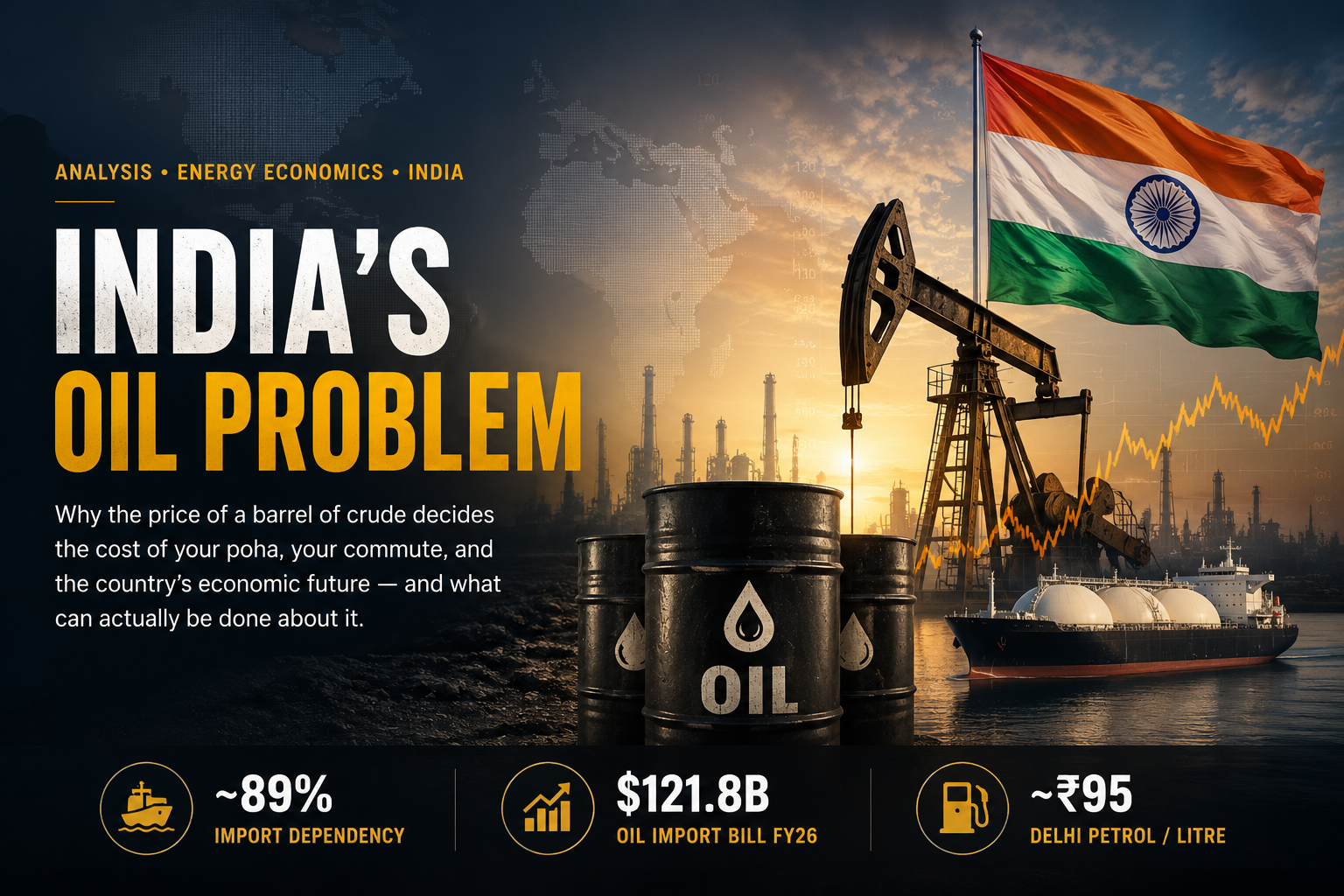
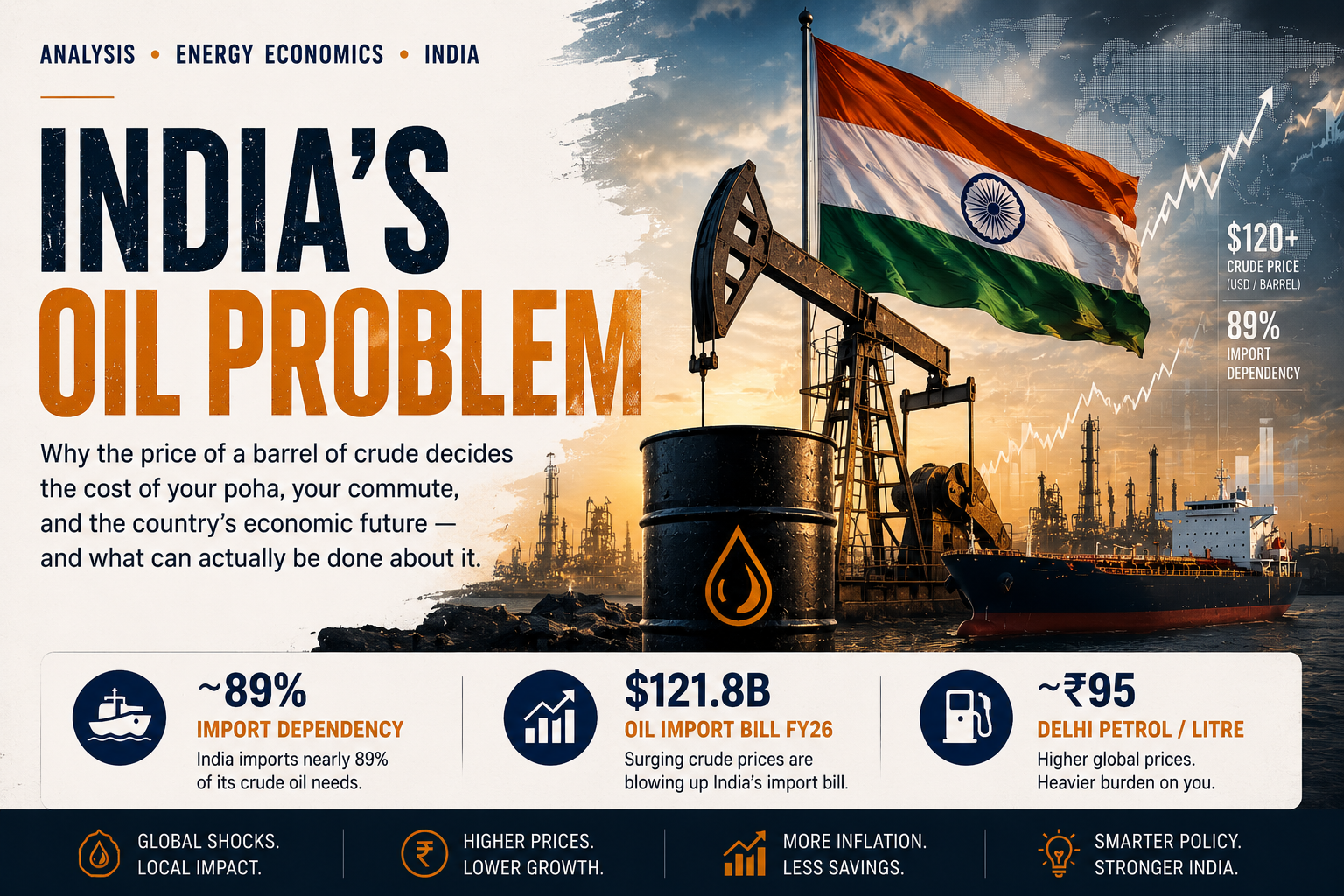
India’s Oil Problem
Why the price of a barrel of crude decides the cost of your poha,
your commute, and the country’s economic future — and what can actually be done about it.
Import Dependency
Oil Import Bill FY26
Delhi Petrol / Litre
Why Should You Care About Crude Oil?
Oil is the invisible ingredient in almost everything. It’s in the freight that brings vegetables to your city’s mandis. It’s in the fertiliser that grew the wheat in your roti. It’s in the plastic packaging around every FMCG product on a supermarket shelf. When crude oil prices rise, a pressure wave travels silently through the entire economy — and by the time it reaches your dinner table, it has multiplied.
India is particularly exposed. The country imports roughly 89% of its crude oil needs. That single dependency means that decisions made in Riyadh, Tehran, or Washington D.C. have a direct line to petrol prices in Vadodara, onion prices in Nashik, and interest rate decisions in Mumbai.
In 2026, that dependency became a crisis. The closure of the Strait of Hormuz — through which over 20% of the world’s oil passes — sent Indian crude basket prices surging past $120 per barrel, putting the government, consumers, and businesses all under simultaneous pressure.
Current Prices: Where Things Stand
India’s crude basket averaged $113.49 per barrel in March 2026,
up sharply from $72.47 per barrel a year earlier. At the retail level,
petrol in Delhi is around ₹94–95 per litre, and diesel around ₹87–88 per litre.
Crude Basket / Barrel
Delhi Petrol
Delhi Diesel
Global Comparison: India vs. The World
India is not the most expensive place to buy fuel — not even close.
But the real question is whether Indian incomes can absorb the same
percentage increase that richer economies can.
The answer, clearly, is no.
| Country | Approx. Price | Context |
|---|---|---|
| 🇭🇰 Hong Kong | ₹291+ / litre | Higher income buffer |
| 🇩🇪 Germany | ₹220+ / litre | Higher income buffer |
| 🇬🇧 United Kingdom | ₹204+ / litre | Higher income buffer |
| 🇮🇳 India (Delhi) | ~₹95 / litre | ▲ Highlighted |
| 🇺🇸 United States | ~₹79 / litre | Higher income buffer |
Note:
India appears “cheap” on this chart, but per-capita income comparisons tell a very different story.
A German spending ₹220/litre has roughly 5× more monthly income to absorb it than an average Indian.
“`
7 Ways Oil Prices Hit You — Hard
The Price Memory Problem
Think back: diesel was ₹70/litre in 2020. Today it’s ₹88. That’s a 26% rise in the input cost of every truck that moves every product in India. The gap between what prices were and what they are now creates psychological and economic friction — families recalibrate budgets around the old normal, not the new one.
Inflation Shock vs. Gradual Rise
Economies can absorb predictable, slow price increases. What they hate are surprises. Imagine poha costs ₹40 per plate today — tomorrow ₹60. That sudden jump is psychologically devastating for consumers and operationally catastrophic for small restaurants, street vendors, and anyone with a fixed-price contract. Oil volatility does exactly this — at scale, across the entire supply chain.
Growth Illusion: The Papad Problem
Here’s the trap: when prices rise, nominal GDP goes up. A papad that was ₹5 now sells for ₹8 — revenues look higher, growth looks real. But if the actual number of papads sold stayed the same, nothing productive happened. High oil inflation can create a statistical mirage of growth while actual living standards decline.
New Businesses Can’t Find Capital
Oil price volatility distorts investment. When crude spikes, investors rush into energy stocks and ‘safe’ assets. Green energy startups, tech ventures, and consumer businesses struggle to attract funding. Entrepreneurs who built their projections on stable fuel costs find their margins wiped out before launch. Once prices stabilise, capital returns — but the businesses that couldn’t survive the gap are already gone.
The Government Budget Crunch
India’s FY 2025–26 crude import bill was $121.8 billion. When global prices rise, the government faces a brutal choice: pass the cost to consumers (triggering inflation) or absorb it through higher borrowings (blowing up the fiscal deficit). The three public sector OMCs — IOC, BPCL, and HPCL — booked a combined loss of ₹27,276 crore in just the first half of one high-oil year.
The Rupee Falls
India pays for oil in US dollars. When the import bill rises, demand for dollars increases and the rupee weakens. In 2025, the rupee depreciated roughly 5% against the dollar, reaching a record low of ₹92.34. A weaker rupee makes all dollar-denominated imports more expensive, not just oil — it also raises India’s cost of servicing foreign debt, creating a vicious cycle.
Recovery Is Brutally Slow
The most underappreciated fact about oil shocks: the damage is easy to inflict and extraordinarily hard to reverse. Businesses that closed don’t reopen automatically. Workers displaced don’t snap back. Supply chains reconfigured around high prices don’t unwind cheaply. Inflation, once embedded in wage expectations and contract pricing, is sticky. An economy scarred by an oil shock takes years — not months — to fully recover its trajectory.
Before the Solutions — A World in Trouble
India’s pain is real, but it’s not unique. The current oil crisis has hit every import-dependent economy hard, and even the major producing nations are under strain. Here’s a quick map of where the world stands:
Western Economies
Petrol in Germany hit $2.47 per litre in March 2026 — an all-time high. In the UK, it crossed the equivalent of ₹204 per litre. These nations suffer too, but their social safety nets, energy diversification, and higher per-capita incomes give them buffers India simply doesn’t have.
Hong Kong
At ₹291+ per litre, Hong Kong remains the world’s priciest place to fill a tank. Limited refining infrastructure, high land costs, and significant fuel taxes create this extreme. Notably, Hong Kong’s service-and-finance economy can absorb high fuel costs in ways that a manufacturing or agricultural economy like India cannot.
Iran & Strait of Hormuz
The conflict that erupted in early 2026 resulted in the closure of the Strait of Hormuz — the world’s most critical oil chokepoint, through which roughly 20 million barrels per day pass. Iran itself, despite massive oil reserves, faces crippling sanctions, infrastructure damage, and export blockades. The IRGC is now reportedly charging tolls on ships transiting the Strait — a highly destabilising precedent.
OPEC Nations
Saudi Arabia, Iraq, Kuwait, and UAE — India’s traditional West Asian suppliers — have all seen supply chains disrupted. India’s crude import volumes from West Asia fell 17% year-on-year in March 2026. The UAE’s departure from OPEC on May 1, 2026 has further weakened the cartel’s ability to manage global oil prices.
“The closure of the Strait of Hormuz is the largest supply disruption in the history of the global oil market.”
International Energy Agency · March 2026
What Can India Actually Do?
There are no quick fixes. But there is a credible playbook — if India has the political will and the fiscal bandwidth to execute it. Here are the most meaningful levers.
Accelerate The Energy Transition
India has committed to 500 GW of renewable energy capacity by 2030. This is not just a climate goal — it’s the most powerful long-term cure for oil dependency. Electric vehicles, green hydrogen for industry, and solar-powered agriculture pumps reduce the demand side of the equation. Clean energy subsidies in India rose 31% year-on-year in FY 2024 — the direction is right, but the pace needs to accelerate.
Expand & Fill Strategic Petroleum Reserves
India’s three underground caverns at Visakhapatnam, Mangaluru, and Padur hold a combined capacity of 5.33 million tonnes — enough for only 9.5 days of demand at full capacity. In March 2026, they were just 64% full, covering roughly 5 days. India needs to expand SPR capacity to at least 90 days — comparable to IEA member standards — and build a discipline of filling reserves when global prices are low.
Diversify Crude Sources
India has already taken a step in the right direction by sourcing discounted Russian crude since 2022. In 2026, it is pivoting toward the US, UAE, and West Africa to reduce West Asian dependency. No single region — and no single geopolitical conflict — should be able to hold India’s energy security hostage. Long-term agreements with diverse suppliers, denominated partly in rupees, reduce dollar demand pressure.
Revive Domestic Exploration
India’s domestic crude production has been declining year-on-year since June 2024 — down 2.5% as recently as May 2025. Ageing oil fields, slow capital expenditure, and bureaucratic delays have allowed domestic output to stagnate. Accelerating OALP rounds and offering better fiscal terms to attract private and foreign investment in exploration could meaningfully dent import dependency within a decade.
Settle More Oil Trade In Rupees
India has begun negotiating oil purchases in Indian rupees rather than US dollars — particularly with Russia and some Gulf states. This reduces demand for dollars in the forex market, eases pressure on the rupee, and reduces currency risk. Deepening the Rupee Trade Settlement framework is a medium-term but transformative step toward reducing the ‘dollar squeeze’ that accompanies every oil spike.
Rationalise Excise & VAT On Fuel
A significant portion of retail fuel price in India is taxes. A revenue-neutral mechanism that automatically reduces excise duty when crude crosses a threshold would smooth the shock for ordinary households while keeping fiscal targets intact. Bringing petrol and diesel under GST would also increase transparency and reduce state-level price volatility.
Kab Tak? — When Will Things Get Better?
There is no single moment when the picture becomes clear. The recovery unfolds in layers, each with its own timeline.
Immediate Stabilisation
If the Strait of Hormuz disruption eases and geopolitical tensions de-escalate, crude prices can come off their peaks fairly quickly. Goldman Sachs projects Brent averaging around $75/bbl over the next year in its base case. Retail fuel prices in India can respond within weeks of a crude price drop — but only if OMCs have cleared their losses and the government reduces excise duties.
Fiscal & Inflation Recovery
The government’s fiscal deficit — stretched by oil subsidies and higher borrowing — takes 2–3 budget cycles to meaningfully consolidate. Retail inflation is sticky: it doesn’t fall as fast as oil prices do. Expect the broader economic hangover from the 2026 oil shock to last through FY 2027–28.
Structural Diversification Starts Showing
This is the window where policy choices made today will begin to pay dividends. If India accelerates EV adoption, fills strategic reserves during price troughs, and revives domestic exploration — by the early 2030s, the economy’s exposure to any single oil shock will be meaningfully reduced. Import dependency could begin to fall below 80% for the first time in decades.
Structural Energy Autonomy — If Choices Are Made Now
The long-run picture is genuinely hopeful — but only with consistent execution. India has the solar irradiance, the engineering talent, the domestic demand base, and increasingly the capital to build a fundamentally different energy economy. The countries most resilient to oil shocks in the 2030s and 2040s will be those that made hard infrastructure and policy investments in the 2020s.
DATA & SOURCES
Research & Reference Material
This analysis draws upon government datasets, industry reports,
market intelligence, and international energy research published
between FY25–FY26.
Government & Public Data
- India Crude Basket Prices : PPAC — Petroleum Planning & Analysis Cell,
Government of India - OMC Losses Data : Business Standard — India import dependency (88.6%) — PPAC, April–November FY26
- Hormuz Disruption Analysis : Reuters — IEA, Brookings Institution, LNRG Technology (March 2026)
- Goldman Sachs price forecasts : Reuters — SPR capacity — PIB / Parliament, March 2026
- Germany petrol ($2.47/L) : Reuters — Trading Economics/en2x · Hong Kong petrol — GlobalPetrolPrices.com
- LPG under-recoveries : Reuters — IISD Energy Policy Report 2026 · Rupee depreciation — IEEFA
- FY26 crude import bill ($121.8B) : Reuters — Business Standard, April 2026